Cachaça: The Rum That Filed for Divorce

Cachaça: The Rum That Filed for Divorce

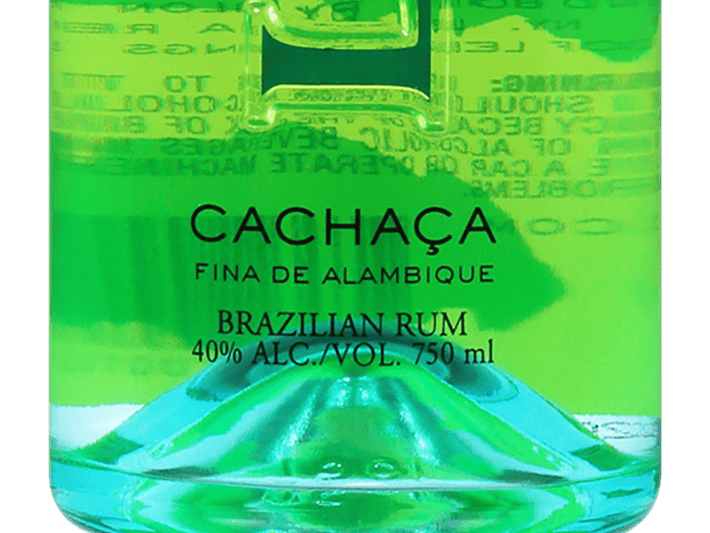
As the story usually goes, rum was born sometime around 1650 in the English colony of Barbados. Problem is, the Portuguese were already distilling sugarcane spirit in Brazil decades earlier. Documentary evidence points to the early 1600s, which predates all evidence of rum in Barbados.^6 The original cane spirit of the Americas is actually cachaça, not rum. For most of the 20th century, cachaça was exported to the United States under the label of "Brazilian rum". Today, that label has been scrubbed from bottles. The official Brazilian position, backed by decades of lobbying and legal legwork, is that cachaça is not rum; it is its own thing in a separate category. Cachaça must be known as a unique spirit that happens to be made from sugarcane, but is absolutely, categorically, not rum. How did we get here, and are they right? Before we dismantle the myths, we need to understand what rum is. The West Indies Rum and Spirits Producers' Association (WIRSPA) is the trade body representing much of the English-speaking Caribbean's rum producers, and probably the group with the greatest authority to tell us what the word "rum" means. According to them, the rule is crystal clear: "If the product is fermented from sugar cane juice, syrup or molasses and distilled below 96% alcohol it is rum, pure and simple".^7 That's it. Around that foundation, nearly every other production choice is allowed to vary: the type of still, unaged or aged, the type of tree the cask is made from, how much sugar is added, if any, or how many times it passed through the still. With that definition in mind, let's work through the case, myth by myth. --- Myth: Cachaça Has a Fundamentally Different Production Process The Claim: Rum is made from molasses (except rhum agricole), while cachaça is made from cane juice.^1^2 Since the opening of Alcoholes Finos Dominicanos, Ron Barceló has been made with sugarcane juice, despite still tasting like a classic Dominican rum. Yes, a vast amount of rum is made from molasses. Jamaican, Demerara, Barbadian, and Puerto Rican rums, along with the world's biggest sellers (Bacardí, Captain Morgan, Tanduay, Havana Club), are overwhelmingly molasses-based. However, the rum category is far more diverse. The Dominican Republic's Ron Barceló bases its own distillation on fresh cane juice, yet it still tastes like a classic Cuban-style ron. Many of Mexico's new distillers are crafting cane juice rums. Even Jamaica's Worthy Park released a cane juice rum to great success. Guatemala's Ron Zacapa and Ron Botrán are distilled from sugarcane syrup, not juice or molasses. Some Haitian clairins use cane juice, while others are distilled from cane syrup. If base material were enough to split the category, two very typical Dominican rums, molasses-based Brugal and juice-based Barceló, would have to sit on separate shelves. Clairin Sajous would be separated from Clairin Le Rocher, and the liquor store would need new shelves for whatever marketing story Dictador is telling this year. Cachaça's base material may be less common, but it is absolutely a variable within the rum family. The Claim: Due to its raw sugarcane juice base, cachaça is more grassy and tastes more like tequila, while rum is heavy and sweet.^1^2^3 This claim only works if your entire reference point for rum is Captain Morgan. Is rhum agricole not rum? Is clairin not rum? Are the cane juice rums of Oaxaca not rums? Are they all heavy and sweet? It makes more sense to contextualize cachaça against the rums of its actual geographic neighbors. Panama, Costa Rica, Colombia, Venezuela, and Guyana, which tend toward a heavier, sweeter molasses style. In this regional context, cachaça does stand out. But standing out from a regional style does not remove a spirit from its overarching category. The Claim: Cachaça's single-pass, low proof distillation and low sugar content makes it more rustic.^2 It is true that in Spanish-style rum production, spirits are often distilled to near-neutral alcohol, diluted, aged, and sometimes sweetened heavily. But there is nothing about this that is inherent to all rum production. Haitian clairins are commonly distilled just once in traditional pot or small creole column stills, then bottled immediately at still strength with no added sugar. Cachaça resembles clairin or agricole more closely than many Spanish-style rums, but that doesn't make it outside of the category. Furthermore, let's address added sugar. Cachaça is often marketed as a more natural spirit than rum, yet Brazilian law actually permits up to 6g/L of added sugar.^5 This is more than Jamaican rum, whose GI does not allow for any added sugar. However, many Central and South American rums operate in less scrupulous ways, where "premium" rums have lots of sugar and other additives to hide imperfections, becoming essentially adult Hawaiian Punch with big numbers on the front that don't actually represent an age statement. In comparison to that, cachaça's 6g/L ceiling is pretty modest. The point isn't that cachaça is more or less pure than rum, but rather that it sits comfortably within rum's existing spectrum of sweetness. The Claim: Rum is aged in ex-bourbon barrels, while cachaça is aged in casks built from native Brazilian trees, such as amburana, which give it a unique flavor.^1^2 Ex-bourbon barrels are common because they are cheap and abundant, but this is not a requirement for rum. Many Spanish-speaking countries, such as Guatemala and the Dominican Republic, make use of Spanish sherry casks for aging, and French-owned brands, such as Planteray and Nicoya, also finish their rums in cognac casks. Japanese whisky producers use mizunara oak. If we created a new spirit category every time someone used a different tree, the back bar would need its own zip code. And critically, aging in native woods is not a strict requirement of cachaça. Cachaça can be consumed unaged (branca/prata), and several major brands, such as Ypióca and Novo Fogo, have begun aging their cachaça in ex-Bourbon barrels. This is driven by a mix of economic realities and growing concerns over the deforestation of Brazil's endangered forests.^8 The Claim: Rum must be aged, while cachaça can be either aged or unaged.^3 It's so sad that the internet is constantly providing false information about my area of expertise. Fortunately, it's very useful and always right about topics I know very little about! If some of these claims sound silly, that's because they are; especially this one. It erases spirits of great cultural importance, such as rhum agricole blanc, Wray & Nephew white overproof rum, Haitian clairins, and others. This one comes from Serious Eats, which I found on the first page of Google if you search "rum vs cachaca". In fact, all 3 sources I used for all of these claims come directly from the first page of Google. If you are going to publish an authoritative, definitive guide on a major platform, and you can't even be bothered to spend five minutes verifying the most basic, easily searchable fact about one of the world's most popular spirits, why should I trust your pizza dough recipe? Also, fun fact: aged cachaça (cachaça envelhecida), by law, doesn't actually have to be fully aged. You can blend aged and unaged cachaça, and as long as at least 50% of it is aged for at least 1 year, it can still legally be called aged cachaça.^5 --- Myth: Cachaça Is Defined as a Separate Spirit The Claim: Rum can be made anywhere in the world, but cachaça can only be made in Brazil.^1 This is a variation of the pervasive "rum has no rules" myth. On its face, the claim is true: cachaça can only be made in Brazil. However, geographic protection is normal. Martinique's Rhum Agricole AOC is strictly geographically bound to Martinique, yet no one argues that it is not a rum. We would not say that rhum agricole, Jamaican rum, and Guatemalan rum are not rums simply because rum can theoretically be made anywhere, while those specific styles can only be made in their respective countries. Geographic protection dictates where and how a spirit is made, but it does not change what the spirit is. The Claim: Brazilian law officially defines cachaça as a spirit separate from rum.^2 Let's start with the United States, the largest importer of cachaça by dollar amount.^12 Brazil used to have to declare it as "Brazilian rum" on US labels. However, after some diplomatic horse-trading in which Brazil agreed to recognize Bourbon and Tennessee Whiskey as protected products in the Brazilian market, the Alcohol and Tobacco Tax and Trade Bureau (TTB) ruled that cachaça is a type of rum that is a distinctive product of Brazil, allowing it to be labeled simply as "cachaça", with the "rum" qualifier now optional.^10 But cachaça is still unequivocally defined as rum, and cachaça imported into the US must still meet the base production requirements of rum: fermented from sugarcane products, distilled below 96% ABV, and bottled at no less than 40% ABV (while in Brazil the minimum is 38%). The European Union tells the same story. It defines rum as a spirit that is fermented from sugarcane products, distilled below 96% ABV, and bottled at no less than 37.5% ABV, and may not be flavored, nor sweetened above 20g/L.^11 Cachaça does not appear as its own separate category anywhere in Annex I, and it falls under the general rum definition. So, if you live in the US or the EU, legally, cachaça is rum. But many countries have quirks in their laws. We all know the saying: "It's not called Champagne unless it comes from the Champagne region of France, otherwise it's just a sparkling wine". But actually, the U.S. has a grandfather clause that allows some American producers to label their sparkling wine "Champagne", much to the chagrin of the French. In 2021, Russia amended its alcohol law so that only Russian-made sparkling wine could carry the unqualified Russian word for "Champagne" (Shampanskoye), forcing French Champagne houses to label their product as "sparkling wine" for the Russian market. It should be noted that Brazil maintains two legal categories for sugarcane spirits: aguardente de cana, a less-regulated tier of sugarcane spirits, and cachaça, a subset of aguardente de cana that is a tightly controlled premium product. When Brazil campaigns for international recognition of cachaça as something other than rum, it isn't asking for the same distinction to be made for aguardente de cana. The broader, cheaper, less regulated parent category can continue sitting beside Captain Morgan, and Brazil doesn't object. The lobbying only begins when the designation threatens the price point. The Claim: The caipirinha is the national cocktail of Brazil, and it can only be made with cachaça, not rum.^1 Some argue that a caipirinha is just a daiquiri.^13 Let's acknowledge one thing: the caipirinha is not a daiquiri. The muddling of fresh lime wedges with granulated sugar extracts different oils and creates a completely different texture than a shaken cocktail of lime juice and simple syrup. The caipirinha is a uniquely Brazilian invention, and it deserves its own name. A Cuba Libre is a uniquely Cuban invention, and we would not reduce it to merely a "rum and Coke". But we also don't decide that Cuban rum is therefore a separate category of spirit. A Manhattan is not an Old Fashioned. We respect these distinctions because they matter to the people who drink them. The caipirinha is Brazil's mixed drink, but the fact that it has a national identity doesn't mean the liquid in the bottle stopped being rum. --- Myth: Cachaça Came First, So It Can't Be Rum The Claim: Cachaça predates rum. Therefore, it is not a type of rum.^2^3 While the exact genealogy of early cane spirits is messy, the evidence that we have of distilling cane in Brazil predates that of Caribbean rum. In at least one case, we know that the Dutch were distilling cane spirits in Pernambuco before the Portuguese expelled them in 1654. Many of those settlers took their pot stills and their expertise to Barbados, where they put them to work on the island's sugarcane plantations.^4 In general, though, the broader picture is a complex and interconnected one, where tafia, guildive, aguardiente, and aguardente de cana all developed in parallel across colonial towns, as workers distilled whatever sugarcane product was at hand, and influenced each other through trade and migration. The idea that someone in Barbados looked at decades of Brazilian distilling and thought, "You know what? I'll invent something completely different!" is absurd. Cachaça came first, and rum soon followed, but the origins are anything but separate. If anything, the logical conclusion isn't that cachaça is a separate category from rum, but that rum is actually a type of cachaça. Brazil, understandably, does not make this argument. It won't earn them their own shelf at Total Wine. --- Why Brazil Is Fighting This Battle Brazil has fought long and hard to divorce cachaça from the rum category, but the production myths don't hold, and the legal distinction is a political game. But it's a smart game with undeniable benefits. When Brazil lobbies the international community to recognize cachaça as a unique category, they are protecting their premium tier. Rum carries baggage: coconut flavoring, pirates and parrots on labels, $12 handles that you chugged in college and regretted the following morning. Brazil wants to ensure that the world recognizes the craftsmanship and heritage that elevates cachaça above that. Sugarcane crushing in a vertical-roller mill driven by a waterwheel. José Joaquim Freire, 1784.Biblioteca Nacional, Rio de Janeiro. The arrest of Governor Bligh during the Rum Rebellion, NSW Australia, 1808. But it's also more than just marketing. Cachaça was historically the drink of communities of enslaved Africans and runaways, the spirit of the senzala and the quilombo. Portuguese colonizers and the Brazilian elite often denigrated it as rough swill for peasants and slaves, instead importing Portuguese wine and brandy for themselves. When the Portuguese crown banned cachaça multiple times in the 17th and 18th centuries to protect its own wine and brandy exports, drinking cachaça became an act of defiance. In the Revolta da Cachaça, Brazilians overthrew the governor, held Rio de Janeiro for five months, and won back the spirit, further cementing cachaça's place as the spirit of Brazil's people.^9 However, this sort of story is a shared history of the Americas. Spain's ban of aguardiente sparked rebellions across South America and started the First Rum War in Cuba (yes, there was more than one). The American Revolution was fueled in part by anger over the restrictions placed on Barbadian rum, which was later served by the barrel at Washington's inauguration. The entire history of cane spirits in the Americas is one of colonial extraction, enslaved labor, and working-class rebellion. By artificially segregating cachaça, Brazil might think it is protecting Brazilian heritage, but at the same time, it is isolating the very "father of all rums" from its own family tree. Cachaça should have nothing to fear from the word "rum". If Brazil helped invent the family, why should it be insulted by being recognized as part of it? Cachaça producers and exporters benefit immensely from rum's massive global distribution networks, its cocktail culture, its bartender community, its competitions, yet they bristle when a bartender groups them together, or when a liquor store places them on the same shelf. At the end of the day, the definition of rum is broad enough, under US law, EU law, and WIRSPA, to cover many diverse styles, from grassy, salty agricoles to fruity Jamaican funk bombs; from rich, sweet Central American soleras to light, dry Cuban rones. So it's time to call cachaça what it is: great, historic, Brazilian rum. Recognizing cachaça as rum does not erase its identity, but rather, acknowledges that Brazil helped shape the history of the New World's great spirit. So if calling cachaça "rum" feels like a demotion, then perhaps we've simply undervalued rum. --- ^1: Cachaça vs Rum – What Sets Them Apart? – Texas de Brazil(https://texasdebrazil.com/blog/cachaca-rum-sets-apart/) ^2: What Are the Differences Between Rum and Cachaça? – Vinatis(https://www.vinatis.co.uk/blog-rum-cachaca-differences) ^3: The Serious Eats Guide to Cachaça – Serious Eats(https://www.seriouseats.com/what-is-cachaca-how-its-made-taste-versus-rum) ^4: Going Brazilian – Cachaca Regulations Demystified – Cocktail Wonk(https://cocktailwonk.com/2018/06/going-brazilian-cachacas-regulations-demystified-translated.html) ^5: Classification and labelling terminology for cachaça – NIH.gov(https://pmc.ncbi.nlm.nih.gov/articles/PMC10486784/) ^6: American Rum: Brazil – The Rum Historian(https://www.therumhistorian.com/2019/04/22/american-rum-brazil/) ^7: Is Cachaça rum – Distilled Sunshine(https://distilledsunshine.wordpress.com/2017/07/28/is-cachaca-rum/) ^8: One Brazilian Booze Brand Is Leading The Fight For An Un-Endangered Forest - Forbes(https://www.forbes.com/sites/bradjaphe/2018/07/24/one-brazilian-booze-brand-is-leading-the-fight-for-an-un-endangered-forest/) ^9: Cachaça: The People’s Spirit - Distiller(https://distiller.com/articles/cachaca-peoples-spirit) ^10: US TTB 27 CFR § 5.147(b)(1) – ECFR(https://www.ecfr.gov/current/title-27/chapter-I/subchapter-A/part-5/subpart-I/section-5.147) ^11: Regulation (EU) 2019/787 – EUR-Lex(https://eur-lex.europa.eu/eli/reg/2019/787/oj/eng) ^12: 'Cachaça is far more than the Caipirinha!' – Beverage Daily(https://www.beveragedaily.com/Article/2021/03/09/Brazil-eyes-up-potential-for-Cachaca-in-global-markets/) ^13: Caipirinha – Tom Macy Cocktails(https://www.tommacy.com/caipirinha)

2026-07-31

Finding the Sugar Content of Rum (part 2)

Preface: A Different Tool, a Different Property In , we used a hydrometer to estimate added sugar by measuring density. That method is based on the idea that the density of a clean spirit should be at the advertised ABV. Any difference between the expected and actual measurements can be attributed to additives, which, in the case of rum, is predominantly sugar. If you haven't read Part 1, I highly recommend checking it out, as it explains the background and the challenges I am trying to solve. The hydrometer method works well, but a refractometer measures a completely different physical property: the refractive index. Basically, a refractometer measures how much a material bends light. Better yet, because hydrometers and refractometers measure different physical properties, the two instruments complement each other. When used together, they provide a cross-check that is an improvement over relying on either method alone. --- Water has a greater refractive index than air, so the straw in water appears to be bent and disconnected from the part in air. How a Refractometer Works A refractometer measures a liquid's refractive index, which is how strongly a liquid bends light. Digital refractometers shine light through a thin pool of liquid resting on a prism and measure the angle at which that light is refracted. Most instruments you can buy online and at homebrew stores display degrees Brix (°Bx), a scale for measuring sugar in water. By definition, a solution containing 10g/L of sucrose equals 1°Bx. This all works great for sugar dissolved in water, however, spirits throw another variable into the mix, as ethanol also bends light, and a refractometer cannot distinguish between the optical effects of alcohol and sugar. For example, a 40% ABV rum with zero added sugar will still register around 14.8°Bx (instead of 0°Bx), since both sugar and alcohol bend light. So, are we stuck? No, and in fact, in Part 1, we discussed how a hydrometer is also affected by both ethanol and dissolved sugar, and by measuring a baseline for each ABV at 0 added sugar, we can build a table for how much sugar is dissolved in a rum given a hydrometer reading and a known ABV. That means that we are not trying to solve for two unknowns at once. If we know what a sugar-free spirit of a given ABV should read on our refractometer, then we know exactly how much of the total Brix reading to attribute to alcohol. Just like with a hydrometer, we assume that everything left over is added sugar. --- Establishing the Baseline As with Part 1, I first want to acknowledge those who have treaded this ground before me. Three years ago, Will from Rum Runner Labs explored whether a refractometer could be used to estimate the alcohol content of rum(https://rumrunnerlabs.com/musings/can-you-measure-the-abv-of-rum-with-a-refractometer/). His article was one of the first I found while researching this topic, and I highly recommend reading it if you're interested in his approach. Will collected refractometer readings from his own blend of Everclear and water and found this formula: ABV = 0.0572×Brix3 - 2.4305×Brix2 + 37.9142×Brix - 178.0087 While it works for his data, it solves for ABV rather than Brix. This is the opposite of my goal, as we know the ABV from the label, and I am looking for the Brix baseline for a sugar-free spirit. Also, plugging 0 into his formula returns an impossible -178% ABV, which suggests the cubic has been fitted too tightly to the data. Fortunately, Will provided his raw measurement data, which was itself useful. It almost perfectly matches my own, except I measured 1°Bx lower than he did across the board, which is most likely a minor calibration difference between our instruments. So, I had to find a source of truth. I found Refractometer.pl, a chemistry reference website sharing high-precision refractive indices across several substances, including very fine-grained refractometer data specifically on ethanol-water mixtures.^3 Separately, a peer-reviewed paper from Computación y Sistemas shows nearly identical measurements using laboratory instrumentation.^1 I converted their refractive index findings into Brix equivalents using a standard USDA conversion chart,^2 and ethanol % w/w to ABV using OIML tables.^4 I plotted the results: My refractometer readings of sugar-free rum, calculating the curve of best fit that was used in the previous graph. The close agreement between my data, Refractometer.pl, and Comp. y Sist. gives me confidence, particularly around 40% ABV, where I had the most data, and sitting consistently about 1°Bx lower than Will's across the board. Unlike the hydrometer equations from Part 1, I could not find an absolute physical equation relating ABV directly to Brix. Instead, I had to fit a polynomial to the scientific measurements, which we can do with the very fine data from Refractometer.pl and a curve fitting calculator(https://www.standardsapplied.com/nonlinear-curve-fitting-calculator.html) The resulting regression is: Brix = -1.032681274×10⁻⁹×ABV5 + 2.881297284×10⁻⁶×ABV4 − 0.0002926855127×ABV3 + 0.01012294715×ABV2 + 0.2734101604×ABV + 0.0776382054 It's not pretty, but I'm never going to have you do it by hand. There's a calculator at the end of this article that solves it automatically. For that reason, I picked the curve that closely reproduces scientific measurements across the entire range up to the plateau around 79% ABV, even though it's a 5th-degree polynomial. --- Estimating Added Sugar Once the alcohol baseline has been established, estimating added sugar is straightforward. For a given ABV, calculate the expected Brix reading of a sugar-free spirit, and measure the rum with a refractometer. The difference between them is the amount of sugar in the rum. To determine how that difference relates to actual sugar concentration, I compiled refractometer measurements from rums whose added sugar content is already known. Much of this data comes from Planteray, whose transparency regarding added sugar (or as they like to say, dosage) makes them particularly valuable for calibration, as well as measurements of brands such as Diplomatico and Bacardi, whose sugar content is posted on several European spirits websites. The results were striking: Relationship between excess Brix above the sugar-free baseline and known sugar concentration. The readings cluster very close to a linear relationship with a slope of 0.09978704°Bx per g/L of added sugar. This is remarkably close to 0.1. This result is particularly satisfying because Brix itself is defined as 10g/L of sugar dissolved in water. I didn't want to simply assume that the same holds in a 40% ABV spirit, since ethanol changes the physical properties of the solution. Combining the sugar-free baseline with the refractometer reading gives the complete formula: Brixobserved = Brixbaseline + (0.1 × g/L sugar) and, rearranging: g/L sugar = (Brixobserved - Brixbaseline) × 10 A Quick Sanity Check As a simple test, I measured a bottle of Diplomático Reserva Exclusiva, bottled at 40% ABV, and got a refractometer reading of 16.5°Bx. Plugging in the values, we get g/L sugar = (16.5 - 14.8) × 10 = 17 g/L, which is exactly the value on system bolaget(https://www.systembolaget.se/produkt/sprit/diplomatico-35601/), and just 1g/L below the value on alko.fi(https://www.alko.fi/en/products/911397/diplomtico-reserva-exclusiva). Pretty good! That said, I readily admit that this is probably the one value that I have the least confidence in. I could not find any scientific data on the refractive indices of solutions of water, ethanol, and sugar, and my own data is, admittedly, sparse. Hopefully as time goes on and I get more data, I can either confirm this value or adjust it with the additional information. Another interesting phenomenon to note (as seen on ): Ron Cubaney Grand Reserve Tesoro XO 25 Años is very sweet, but as an international brand, it likely caps itself at 20g/L, the legal limit for rum in many countries. I measured it at 28.7g/L on the hydrometer and 12.7g/L on the refractometer. These two measurements are completely different, but it averages right around 20g/L, I presume because I got my sample from an old, nearly empty bottle (from a hotel bar in the Dominican Republic), and the ABV has likely dropped due to evaporation, causing the hydrometer to read high, and the refractometer to read low. In another example, Black Tot Finest Caribbean Rum claims zero added sugar. The bottle was also mostly empty, and I got a reading of 3.5g/L on the hydrometer, and -4.5g/L on the refractometer. Again, the average is close to zero. One final example: my grandfather passed away 10 years ago, and I took his half-finished handle of Smirnoff out of the closet. We know that Smirnoff is 40% ABV and has no added sugar because it's just basic vodka. On the hydrometer it registered as 34% ABV, which suggests 22g/L of added sugar, yet we know it has none. The refractometer returned a reading of 12.8 Brix, which suggests -20g/L of sugar at 40% ABV, or, following the baseline curve of zero sugar, that it has an ABV of 35% with zero sugar (the more plausible explanation). That being said, I would not say that you can confidently take a refractometer reading and a hydrometer reading, and if they're way off, to just average the two and assume the delta is due to evaporative losses from the fact that the bottle is old. That is just one explanation, and it is better to take measurements from new bottles when possible. --- Problems Solved Recall in Part 1, the following problems were identified with the hydrometer method: 1. Sugar is not the only thing that affects density. 2. The method depends on the label ABV being accurate. 3. The method combines two separate curves: sugar in water and alcohol in water. It assumes that the same relationship holds in a mixed ethanol-water solution. 4. Measurement error can easily dominate the result. 5. The method assumes the bottle has not been substantially affected by evaporation. 6. Results apply to the specific bottle in your hand. Sugar additions can and do change between batches. 7. You need 100mL+ of rum for a reading. The improved formula from Part 1 addressed problem 3, though it was barely a problem to begin with. However, a refractometer can do much more. Digital refractometers can be found online for under $50, sometimes under $30. First, it eliminates problems 4 and 7. A hydrometer typically requires at least 100 mL of spirit, enough to fill a graduated cylinder. A digital refractometer, by contrast, requires only a few drops. Digital refractometers are also far cheaper than digital hydrometers. Unlike a digital refractometer, simply reading a manual hydrometer itself introduces human error. Small differences in eye level, meniscus interpretation, temperature correction, or any other visual guesswork can easily change the reading. More importantly, combining the two instruments finally addresses problems 2 and 5. A hydrometer measures density, and alcohol lowers density, while sugar raises density, so the two effects oppose one another. A refractometer measures the refractive index, and both alcohol and sugar increase the refractive index, so the two effects add to each other. Because sugar and alcohol affect the reading in different directions, using both instruments creates a built-in cross-check. If the label ABV is perfectly accurate and sugar is the dominant additive, both instruments should return the same sugar figure. However, suppose a bottle has lost alcohol through evaporation. A hydrometer will interpret the increased density as additional sugar, while a refractometer will measure a lower refractive index because less alcohol remains, causing very divergent readings. So, using the two in tandem, agreement strengthens confidence in the result, while disagreement raises a discrepancy deserving further investigation. --- Limitations The largest uncertainty comes from the sugar calibration itself. While the alcohol baseline is supported by published measurements of ethanol-water mixtures, I could not find any scientific data describing the refractive index of mixtures containing ethanol, water, and varying concentrations of dissolved sugar. The relationship presented here is therefore based largely on measurements of commercial rums whose sugar contents are known, and I only have around 10 measurements currently. Those measurements produce a convenient relationship, but additional data will be needed for more confidence. After around 75% ABV, the curve plateaus, peaks around 80% ABV, then drops. Another limitation appears only at very high alcohol concentrations. Above roughly 75% ABV, the relationship between alcohol concentration and refractive index begins to flatten before eventually reversing. So, a 92% spirit can produce nearly the same refractometer reading as one around 77% ABV. For nearly every commercially available rum this is irrelevant, but for exceptionally high-proof bottlings, the refractometer loses its ability to distinguish added sugar from lower ABV. A refractometer is still usable, but I would say that agreement between the two methods should not be interpreted as cross-checked confirmation for rums above 151 proof. Finally, neither a hydrometer nor a refractometer can identify which additives are present. Both methods rely on the assumption that sugar is the dominant additive, an assumption that appears to hold for the overwhelming majority of adulterated rums, but it is an assumption nonetheless. --- But your formula is scary! Here is a calculator: --- Refractometer Tests > Note: As with the hydrometer method, any calculated value below approximately 5 g/L should be treated as effectively zero. When testing confirmed sugar-free rums at identical ABVs, I observed deviations from the baseline of up to 0.4°Bx. With a larger sample size, variances of 0.5°Bx (which correspond to 5 g/L of sugar) are entirely plausible. Like the hydrometer method, this method cannot distinguish a reading below that from a true zero. For the full table of results including both hydrometer and refractometer readings side by side, see the . --- ^1: Scientific analysis measuring the refractive index of ethanol-water solutions across various ABV spectrums.(https://www.scielo.org.mx/scielo.php%3Fscript%3Dsciarttext%26pid%3DS1405-55462019000100027) ^2: USDA Refractive Index to Brix-Equivalent Conversion Metrics.(https://www.fruitsmart.com/wp-content/uploads/Brix-Table-USDA-Conversion-Chart.pdf) ^3: Refractive index of alcohol at different concentrations(https://www.refractometer.pl/refraction-datasheet-ethanol) ^4: OIML tables converting ethanol % w/w to ABV, p. 48-49(https://www.oiml.org/en/files/pdfr/r022-e75.pdf)

2026-07-07

Finding the Sugar Content of Rum (part 1)

Preface: Why sugar content in rum matters Rum has no rules. You hear this a lot, and just as often you will be immediately met with the response that it's not true. Well, it's as true as saying that whiskey has no rules, or brandy has no rules. Yes, of course, and you can buy E&J brandy or Kentucky Deluxe blended whiskey, but people generally know what they're getting, and they know that if they want the good stuff, then they should spring for the cognac or Scotch whisky. You know, the stuff that has rules. But what is the equivalent of that for rum? I asked AI, and it said Appleton Estate and Ron Zacapa Centenario. Enthusiasts might immediately say "one of these things is not like the other", but what is the average consumer to do? Sweeteners, glycerin, and artificial flavorings can be added without any obligation to tell the consumer. Within the EU, added sugar is capped at 20 g/L for spirits sold as rum, but many international brands face no equivalent restriction, and even EU enforcement depends largely on routine testing by state-run retailers. For years, the only way to check what was actually in a bottle was to send it to a laboratory. That changed in 2013, when a Danish rum enthusiast named Johnny Drejer(http://www.drecon.dk/) published a method that any home enthusiast could replicate with a cheap hydrometer. It's pretty straightforward: hydrometers measure density, and rum with added sugar is denser than a rum of the same ABV without it. If you know what the density should be at the stated ABV, and you can measure what it actually is, the difference gives an estimate of what has been added to change it. In this article, we will dig into the reliability of his approach, but both the Finnish state retailer Alko and Sweden's Systembolaget test spirits for added sugar, and his numbers matched their lab data closely. --- Using a hydrometer to test for added sugar Quite frankly, Drejer deserves the credit here. Many have expanded on his work, but if they could see further, it is only by standing on the shoulders of a giant. The underlying methodology is sound. Hydrometers measure density, and if we can know with a high degree of accuracy what the ABV truly is, then if there is a difference between the observed and stated density, something inside the rum must be causing it. Though he makes it abundantly clear that density is not the same as sucrose, in practice sucrose is often the dominant factor aside from ethanol content, and other contributors, such as glycerin, are usually small enough to ignore for calculations. DuRhum's lab tests, for example, showed that Ron Zacapa contains around 0.3g/L of glycerin(https://durhum.com/here-we-rum/), which would increase its density by less than 0.1%. My hydrometer is only accurate to about 0.5 ABV, which is roughly a 1.25% change in density. But let's do a deep dive into Drejer's methodology. We know how sugar affects the density of water: Curve of density of water based on Brix, from Drejer. For his calculation, Drejer used a rate of 4.00331 ΔBrix⁄Δg/cm³ for his calculation, which is the average slope from 0 to 100 g/L of sugar added.^1 That is a broad range, since most rums seem to stay at or below the EU legal maximum of 20 g/L, but the line is fairly flat, so the approximation works well enough. Sugar adds a pretty consistent change in density to water. The same approach is then applied to the effect of alcohol on water: Curve of density of water based on ABV, from Drejer. From those two curves, Drejer derives the final formulation: (observed density - stated density⁄4.00331) × 10 The factor of 10 converts Brix to g/L. That gives us this reference table: Table used to convert observed and stated ABV into added sugar, from Drejer. --- Why it is imperfect 1. As stated earlier, sugar is not the only thing that affects density. Drejer makes that clear from the start. Glycerin is usually minor, but it does have an effect. Other sweeteners or additives may also change density in ways that do not behave exactly like sucrose. Sugar is still probably the biggest factor, but it is not the only one. 2. The method depends on the label ABV being accurate. By law, ABV has to be very close to what is stated on the bottle, and both the EU and the American TTB allow only a maximum deviation of 0.3%. That makes the stated ABV a solid anchor, but not a perfect one. 3. The method combines two separate curves: sugar in water and alcohol in water. It assumes that the same relationship holds in a mixed ethanol-water solution. That is probably close enough for a practical estimate, but alcohol and water behave in non-intuitive ways. For example, mixing 250mL of water, with a density of 1g/mL, and 250mL of ethanol, with a density of 0.79g/mL, results in a solution with a volume of 480mL and a density of 0.93g/mL (not 500mL of 0.895g/mL as we might expect).^2 Once sugar is added too, the system becomes even more complicated, because sugar dissolves differently depending on how much water and alcohol are present. 4. Measurement error can easily dominate the result. If you are using a cheap 0-100 hydrometer with tight lines, you can be off by a few ABV just from reading the instrument by eye or from small calibration differences. A 1-2 ABV error may not sound like much, but at 40% ABV, a reading of 38% instead of 40% would suggest roughly 8 g/L of added sugar. You ideally want the ABV reading to be accurate to within about 1%, which corresponds to roughly 0-5 g/L of added sugar. That is one reason many people treat 5 g/L or less as effectively no added sugar. 5. The method assumes the bottle has not been substantially affected by evaporation. Ethanol is more volatile than water and evaporates disproportionately from a spirit. A bottle with a compromised seal, such as a worn or dried out cork, will have a measurably lower ABV than the one it originally started with, printed on the label. But the formula uses the stated ABV as its baseline, so any fall in actual ABV caused by evaporation registers as an apparent density increase. That is indistinguishable, by this method, from added sugar. A well-sealed, upright bottle loses very little ABV over a reasonable period, but a frequently used bottle left for an extended time, especially through temperature swings, is a risk for a false positive. 6. Results apply to the specific bottle in your hand. Sugar additions can and do change between batches, sometimes substantially. El Dorado is a well-known example where the sugar content has been adjusted significantly over the years. A hydrometer reading published five years ago for a given label may not reflect what is currently on shelves. Ideally, you would cross-reference the bottling date or batch number, but most producers make this information difficult to determine, and some reviewers don't provide the date of their reading. 7. You need quite a bit of rum for a measurement. Depending on your hydrometer and graduated cylinder, you may need 100-200mL of rum for a measurement. This excludes sample bottles from providing you any results. --- Why it still works But those issues might not even matter. Despite its errors, it is a solid estimate and has proven itself useful. All things considered, 20g/L is really not a lot of sugar in terms of total volume. As such, it may be possible that the effects of saturating the water with sugar such that it affects the bonds with the ethanol content would be pretty minimal at these ratios. Drejer also tested the method by dissolving 40g/L of sugar in a 37.5% ABV spirit and measured it at 25% ABV, which matched the chart closely. I would still be cautious about extreme cases outside the chart, such as a 15% liqueur or a 151 proof rum. --- Can it be improved? A little, yes. Problems 1, 2, 5, and 6 cannot really be solved with a hydrometer. A hydrometer measures density, and that is all it measures. If the liquid contains other density-altering substances, if the bottle is not fresh, if the bottle is mislabelled, or if the formula recently changed, that is simply outside of the method's control. Problem 3 is the one area where a better model is possible. To improve it properly, I would need highly accurate measurements across many data points, with carefully controlled sugar amounts and ABV levels, so that I could determine whether the change in density for sugar in an ethanol-water mixture really matches the change shown in the pure-water charts. That would give a more defensible model, but it is more work than I want to take on right now. What I can do instead is use a more specific formula. Drejer's formula is as follows: sugar (g/L) = (ρobserved ​− ρstated​⁄4.00331)×10^1 This uses one fixed constant, 4.00331, regardless of the ABV. That is a linear approximation, combining the whole typical ABV range into an average. It's a simplification, which makes it easier to use, at the cost of assuming that every unit of density change corresponds to the same amount of added sugar regardless of ABV. We know that isn't true. Adding 40 g/L of sugar to a 37.5% ABV spirit drops the apparent reading by about 12.5 percentage points, but adding the same 40 g/L to a 60% ABV spirit only drops it by about 8 points. A more granular formula would be: sugar (g/L) = 1000 × (ρobserved ​− ρstated​⁄1 − ρstated × ​v) I added 4g of sugar to 37.5% ABV rum, to a final volume of 100mL. This equals 40g/L, and my hydrometer reads 25% ABV. Here, ​v is the apparent specific volume of sucrose in the spirit blend, which is approximately 0.625cm³/g. The amount of volume occupied by a gram of sucrose actually changes based on how much sucrose is already present in the solution, but scientific measurements show that the noise is greater than the measured difference. So, in practice, treating ​v as a constant is a defensible simplification given the data.^3 Also, just to double check Drejer, I took some 37.5% ABV rum (and made sure the initial hydrometer reading is 37.5% ABV), and then carefully dissolved 4g of sugar into it, then topped it up to exactly 100mL and stirred well (equal to 40g/L of sugar). My hydrometer floated at precisely 25% ABV. So, this is a nice agreement, because that means my hydrometer agrees with Drejer's, and my methodology gives an answer very close to Drejer's as well. I added sugar in increments of 20g/L and got the following readings: 55%, 50%, 45%, 40.5%, 36% But what if we explore another end of the scale? One where my formula and Drejer's pretty substantially disagree? I chose 60% ABV and high sugar content because that's the most extreme scenario, and actually, both formulas held up reasonably well. Science is supposed to be reproducible, and that was really the point of this exercise. For the most part, they do. At ABV and sugar content so high that you won't even plausibly encounter it, it appears that my formula is a bit more accurate, but only within a couple percentage points compared to Drejer's. At 37.5% ABV with 40 g/L of added sugar, my formula, Drejer's formula, and the measured result all landed in the same place to within a fraction of a percentage point. If you've been relying on Drejer's hydrometer method for a typical bottle of rum, this is good news! While my formula does not completely align with my data, it is around twice as close as Drejer's formula. --- But your formula is scary! Here's a calculator: The calculator does not produce radically different values from the Drejer table. What it does do is save you from having to read the chart row by row, and it uses the exact formula so you do not need to guess between the lines when the ABV is not an integer. --- Hydrometer tests > Note: values below 5 g/L can effectively be treated as no added sugar, because measurement error and natural barrel-derived compounds can account for that difference.^4 For a complete table of hydrometer test results, see the . --- ^1: Drecon, Drejer's website(http://www.drecon.dk/) ^2: The Lost Volume Demonstration - Carolina Knowledge Center(https://knowledge.carolina.com/professional-growth/activities/the-lost-volume-demonstration/) ^3: Apparent Specific Volumes of Sucrose in Different Aqueous Cosolvent Mixtures at 298.2 K - Pharmaceutical Sciences, p. 325(https://pdfs.semanticscholar.org/20e7/6d53984a0a9bc45abbc257d97a0912b1393f.pdf) ^4: Scientific literature points to about 1.3g/L of glucose derived from barrels due to interactions with spirits(https://www.nature.com/articles/s41598-018-34204-1), so 5g/L is more of a community rule of thumb. It rests on two factors: first, home hydrometer reading error: a 0.5% ABV misread corresponds to roughly 2 g/L of apparent sugar, per Capn Jimbo's error analysis in the Rum Project forums(http://rumproject.com/rumforum/viewtopic.php?f=32&t=1898), and also you can see this for yourself using my calculator tool. Second, the observation is based on laboratory data compiled by Rum Revelations(https://www.rumrevelations.com/post/a-simple-home-test-to-find-additives-in-rum) that verified unsweetened spirits, from countries where adding sugar is prohibited by law, can often still have some amount of detected sugar, but never more than 5 g/L. With these two facts combined, the method cannot confidently conclude that a reading of 5 g/L or below proves added sugar.

2026-06-30
Scoring & Ratings

Scoring & Ratings

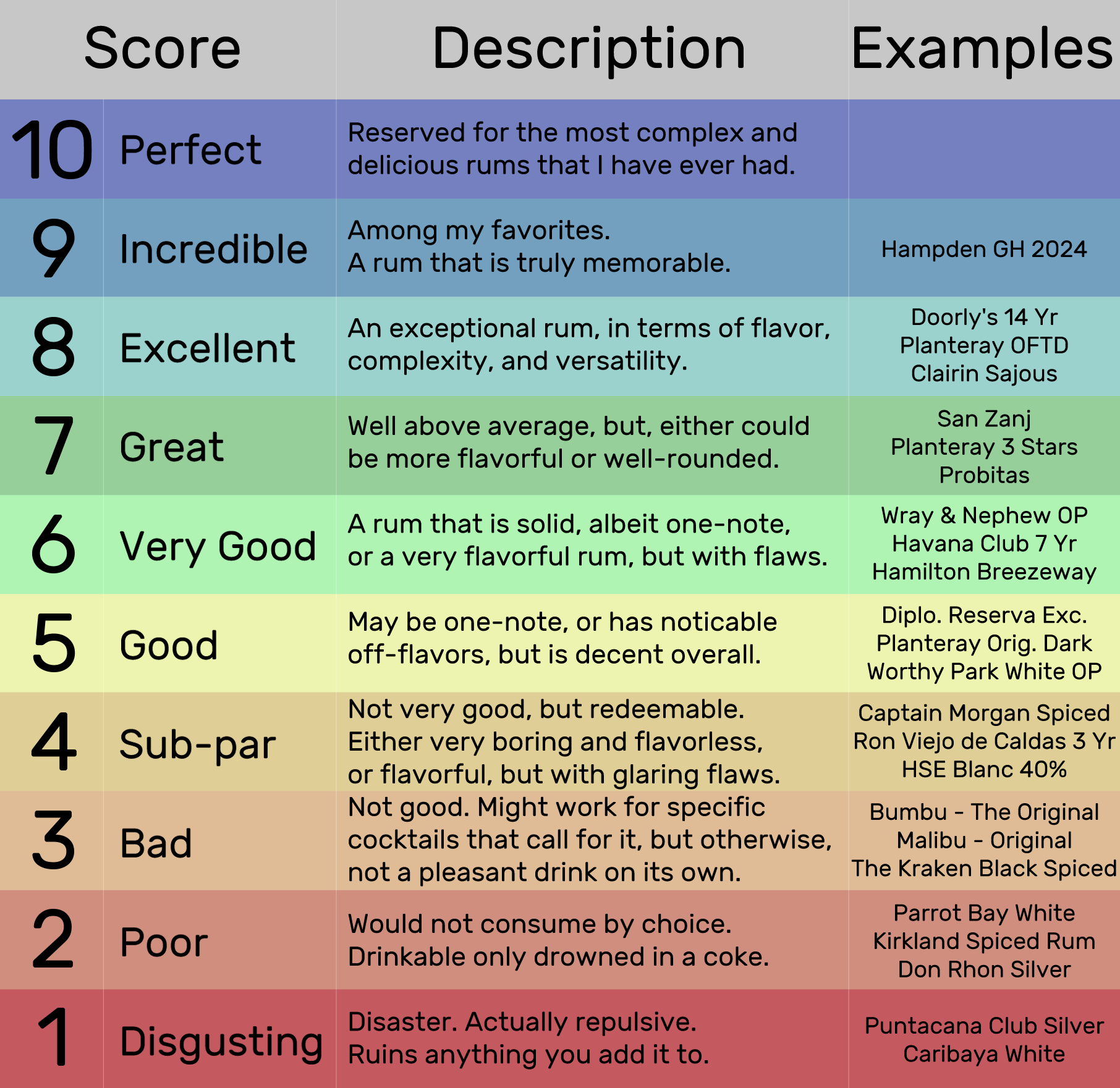
Scoring philosophy Basically I am ripping the rating scale straight from t8ke. It's already a very widely used standard, and my ratings should be 1:1 comparable to anyone else rating with the t8ke. I just added some clarifying context to some of the scores, since some of the descriptions are rather nebulous, and I wanted to explain how a 6/10 could be either a decent sipper but kind of boring, or a very flavorful but chaotic rum with flaws. Rum Ratings Click column headers to sort, and use the dropdowns to filter.

2026-06-11
Analysis on glycerin in rum

Analysis on glycerin in rum

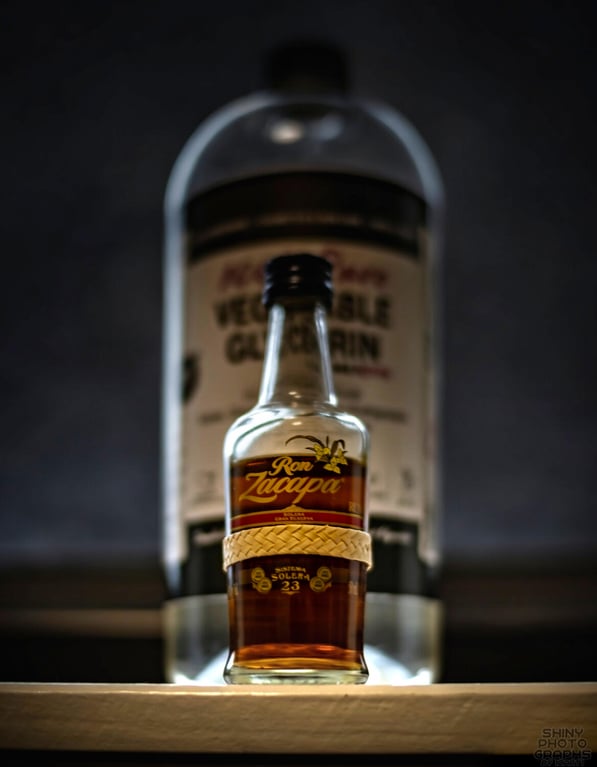
Preface: If You Have Nothing to Hide... For decades, we were sold wonderful stories from producers of premium rum, such as the idea that the smooth, rich character of their high-end bottles came purely from great molasses or "sugarcane honey", slow aging, and traditional craftsmanship. As most enthusiasts know by now, that illusion was pretty thoroughly shattered when people started testing their collections with hydrometers at home. DuRhum even backed this up with actual lab tests(https://durhum.com/here-we-rum/). It turned out that a lot of respected, premium rums were heavily dosed with additives. Zacapa 23, for example, measured 20g/L of added sugar! That is way beyond anything natural barrel aging could impart.^1 Worse, sugar wasn't the only thing they were hiding from consumers. Lab tests also showed that Zacapa 23 contained 0.2-0.4g/L of glycerin (aka glycerol). Glycerin acts as a sweetening agent, but, more importantly, it adds viscosity. It creates those thick "legs" on the side of the glass that people mistakenly associate with age and quality, and gives the spirit a rounded, oily mouthfeel, taking the harsh edges off of young alcohol. However, unlike sugar, there is no quick hydrometer test to see if a brand is slipping glycerin into your drink. I started digging into this while writing reviews for Puntacana Club (by Oliver & Oliver). I had read Rum Revelation's review suggesting they add glycerin(https://www.rumrevelations.com/post/oliver-oliver-s-fake-premium-rums), and The Fat Rum Pirate's review of Zacapa 23 Etiqueta Negra(https://thefatrumpirate.com/ron-zacapa-centenario-sistema-solera-23-etiqueta-negra), where he specifically noted: "Glycerin shouts out at me and it all smells a touch artificial." That piqued my interest, because I had no idea what glycerin actually tasted or felt like in isolation. Was I just missing it? Did I even know what to look for? To figure it out, I decided to mess around with some at home. --- The Experiment For my control, I needed a rum that I knew was totally clean. I went with Kingston 62, a young, somewhat harsh column-still rum from Jamaica. Jamaican regulations strictly prohibit additives, so I treated it as my control. The tricky part is that the amounts used by producers are tiny. The smallest pipette I have drops 0.025mL, which I dissolved into about 63mL of rum (roughly two shots) using 95% vegetable glycerin. Honestly, I didn't think I'd even be able to tell the difference at these levels, but I mixed up four samples: 0g/L (control), 0.5g/L, 1g/L, and a heavy dose of 3g/L. I just wanted to see at what threshold I actually noticed a physical change in what I am tasting. |X|0g/L (control)|0.5g/L|1g/L|3g/L| |---|---|---|---|---| Viscosity (legs)|Zero legs. Forms a thin layer that evaporates quickly.|One or two legs begin to form on parts of the glass, but mostly evaporates quickly.|A lot of legs, all around the glass.|A thick, persistent curtain of legs.| Sweetness|Not sweet. A typical lightly aged white rum.|Not sweet. No perceptible change.|Maybe a bit more sweet, but the rum's own vanilla/coconut flavors really pop.|Noticeably sweet, comparable to a rum with 10g/L of sugar.| Mouthfeel|Very liquidy. No body.|No change. Very liquidy.|Coats the mouth nicely. An oily texture emerges.|Coats the mouth nicely. Full, oily texture.| |Harshness/Burn |Moderate burn. Not a sipper.|Moderate burn. No change.|Wow. Almost no burn. Very smooth.|No change. Almost no burn, very smooth.| --- What did I actually learn from this? Some changes were way more obvious than I expected, while others were pretty subtle. Sweetness isn't the main goal Jumping up to 3g/L made the rum sweeter, but at lower doses I really couldn't feel it. Glycerin isn't nearly as sweet as sugar, so I highly doubt producers are using it primarily as a sweetener, especially since you'd need a lot of it, and there are much stronger artificial sweeteners (like sucralose) that can do the job in microscopic amounts. Kingston 62, no glycerin Kingston 62, 1g/L glycerin The increased viscosity This was the most obvious shift. Even at just 0.5g/L, a totally raw, watery white rum suddenly started forming legs. If you dropped that into a rum that already had a few years of real barrel age, it would easily push it into that thick, "premium" territory. I didn't feel a difference in mouthfeel until 1g/L, which is a massive dose compared to what lab tests usually find. Interestingly, at 1g/L, I could taste the rum's natural flavors better, probably just because the oily texture made it coat my tongue longer. Taking the edge off Glycerin didn't magically make a young rum taste like a 15-year aged premium rum, but at 1g/L, it drastically cut the alcohol burn. It was a serious jump in perceived "smoothness." Given that a lot of casual consumers equate "smoothness" with "quality," it's completely obvious why mass-market brands are tempted to sneak a little bit into their blends. --- Can you actually detect glycerin at home? As far as I can tell, not really. Even at 3g/L, which is nearly ten times the amount found in the Zacapa lab tests, I didn't pick up a distinct artificial, chemical, or "glycerin" taste. The only thing I noticed was a thicker, oilier spirit. Because you can also get a thick, oily spirit from natural aging, heavier distillates, or a higher ABV, trying to guess if a rum has glycerin based on taste or mouthfeel alone feels like it's purely based on vibes. There is maybe one visual cue you can look for, but again, take this with a massive grain of salt. If you have a rum that is low ABV (40% or under), very lightly aged, and completely dry (no added sugar), there is virtually no chemical reason for it to have thick legs. If you swirl it, and it clings to the glass like syrup instead of evaporating off in a thin film, perhaps something is up. But even then, it's rarely just glycerin. Rums that resort to glycerin usually use a bunch of additives, like sugar, meaning that if you see suspicious legs, sugar is probably having a greater effect anyway. So while heavy legs on a young, low-proof rum is suspicious, attributing it definitively to glycerin is impossible. --- ^1: Scientific literature points to about 1.3g/L of glucose derived from barrels due to interactions with spirits(https://www.nature.com/articles/s41598-018-34204-1).

2026-04-04